Heated Driveways: How They Work & What They Cost in the GTA (2026)
A plain-English guide to hydronic snow-melting driveways — the layers under the surface, how installation goes, and honest 2026 cost ranges for the Greater Toronto Area. No jargon, no pressure — just what we actually build.
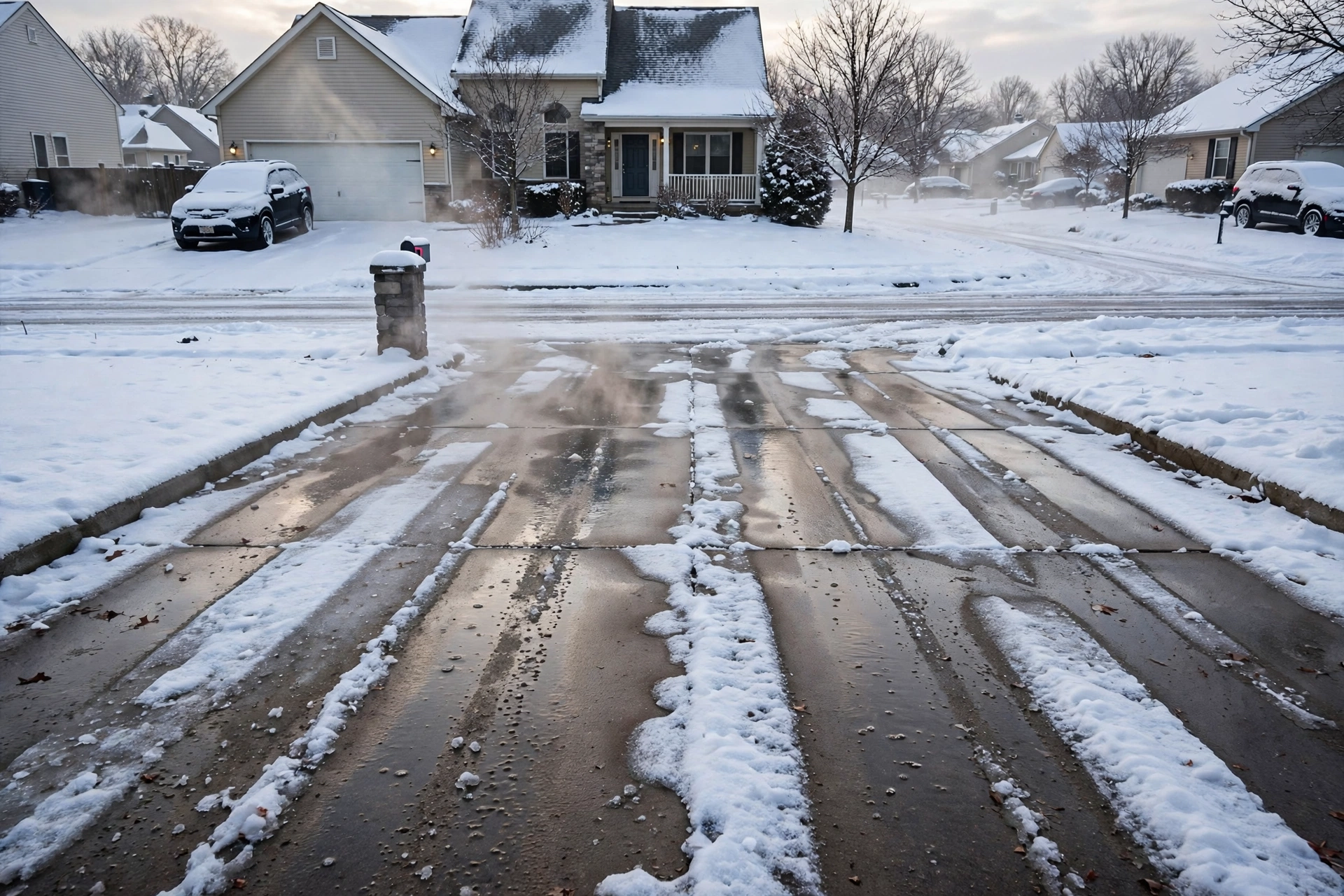
How a heated driveway works
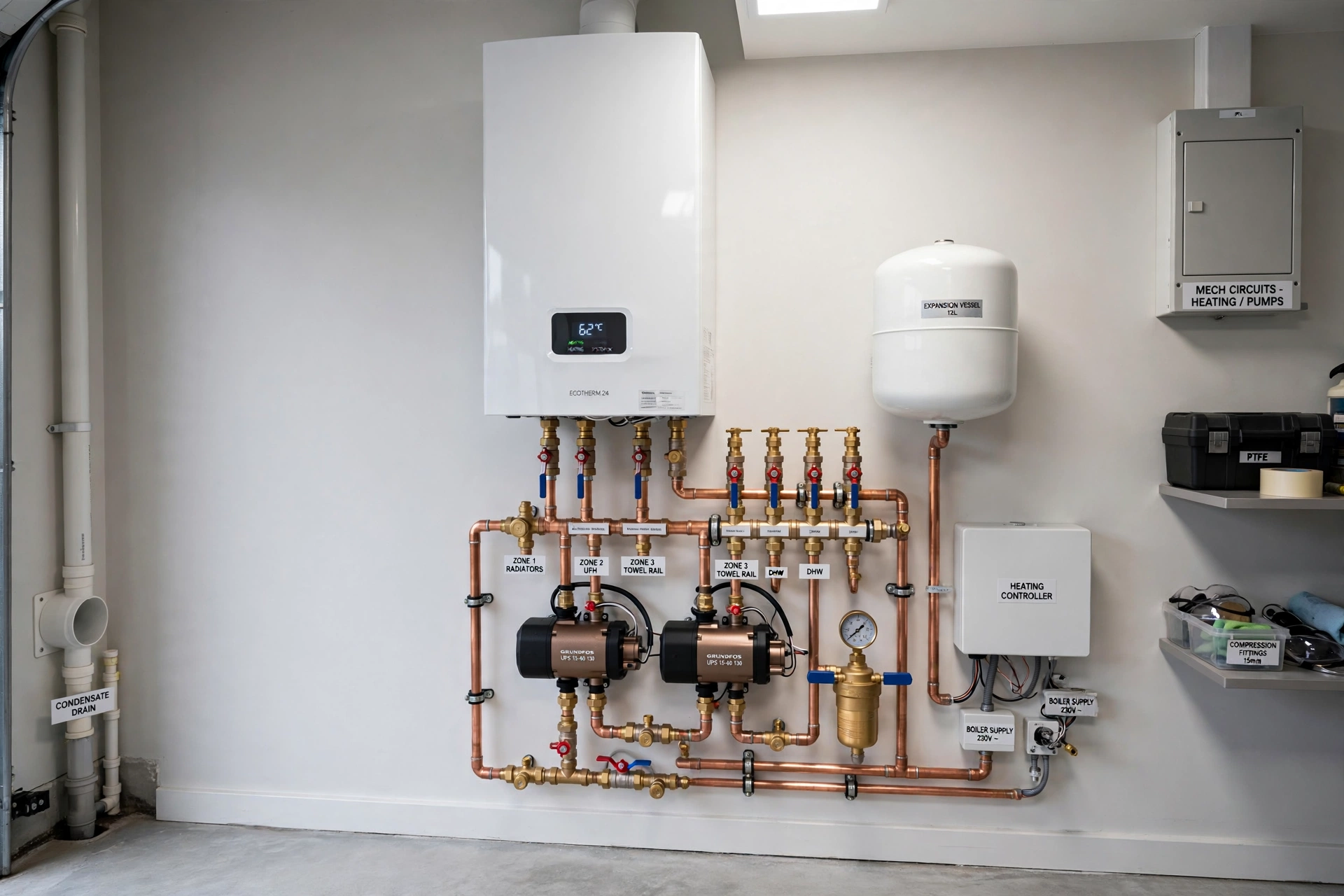
Think of it like radiant floor heating, but outside. Flexible PEX tubing is laid in loops beneath your driveway and connected to a boiler — usually a compact unit mounted on the garage wall. Warm water circulates through the tubes, and the surface gently heats up.
A smart snow sensor watches the weather for you. When snow starts falling, the system turns itself on and melts it on contact. You wake up to a clear driveway — every storm, all winter. No shoveling, no salt, no ice.
It is also the kindest thing you can do for a paved surface: no freeze-thaw salt damage, no shovel scrapes, no snowbanks piled on the lawn edge. The heating is invisible — the result is not.
What’s under the surface
Every heated driveway we build is a stack of layers, each with a job. From the ground up:
Compacted soil
The prepared subgrade — graded for drainage so water never sits under the system.
Granular base
Compacted crushed stone that carries the load and lets water drain away from the slab.
Rigid insulation panels
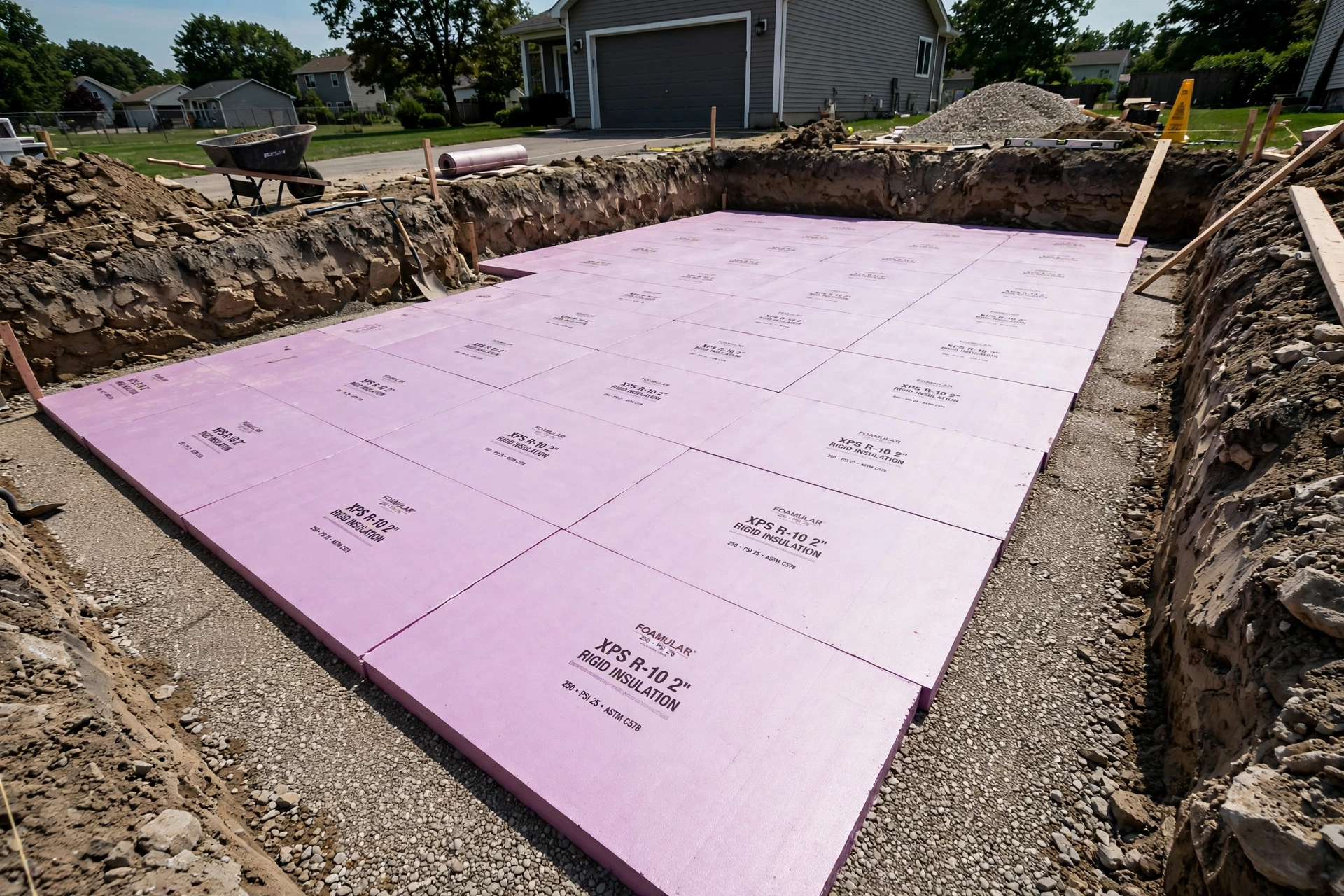
High-density foam that pushes the heat up toward the surface instead of losing it into the ground.
PEX tubing on mesh
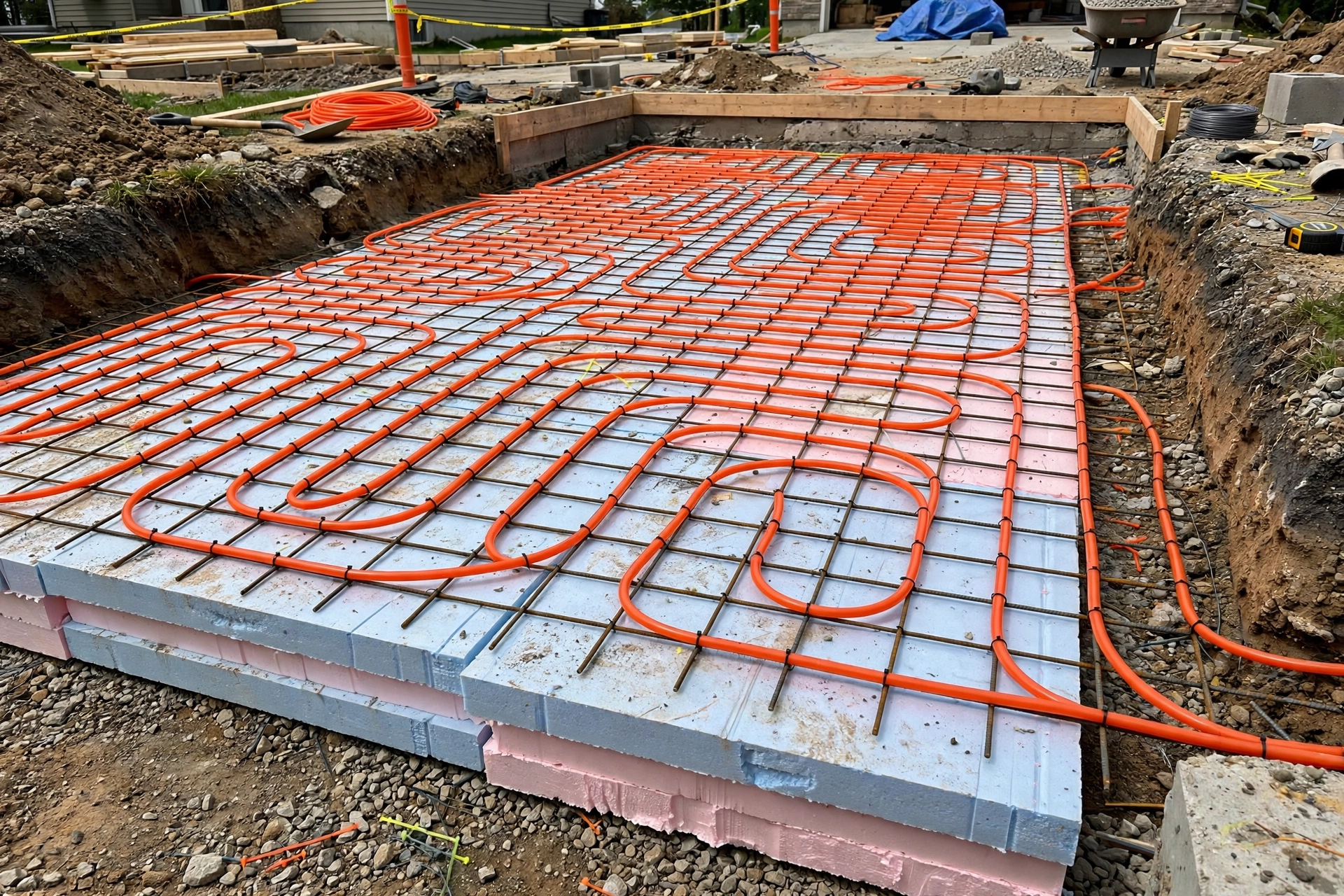
Orange hydronic tubing clipped to steel mesh in even loops — the warm-water “radiator” of the driveway.
Concrete slab
The tubes are encased in concrete, which spreads the heat evenly and protects the tubing for decades.
Finish surface
Your choice on top: asphalt, plain concrete, interlock pavers or natural stone.
How installation goes
Eight steps, one coordinated crew — here is the sequence from first dig to first snowfall:
- Site prep & excavationLayout, permits where needed, and digging down to the right depth for the full layer stack.
- Base & drainageGrading and compacted granular base, with drainage so water never pools under the slab.
- InsulationRigid foam panels laid tight over the base to direct heat upward.
- PEX layout & pressure testTubing clipped to mesh in even loops, connected to the manifold, then pressure-tested before any concrete is poured.
- Concrete pourThe slab encases the tubing, spreading heat evenly across the whole driveway.
- Boiler, manifold & controlsThe compact boiler, pumps and smart controls are installed in the garage and piped to the loops.
- Finish surfaceAsphalt, concrete, interlock or stone goes on top — your choice, priced separately.
- CommissioningFull system test, sensor calibration and a walkthrough so you know exactly how it runs.
What it costs — 2026 GTA ranges
Honest numbers for a typical ~1,000 sq ft driveway, in Canadian dollars. Every figure is a range, because every property is different:
| Item | 2026 GTA range (CAD) | Notes |
|---|---|---|
| PEX tubing + installation | $7,000 – $12,000 | Sample figure: ~$9,500 for 1,000 sq ft |
| Boiler + mechanical equipment + controls | $9,000 – $19,000 | Depends on the exact heating design |
| Excavation | Depends on site conditions | Priced as a separate line item after assessment |
| Granular base | Depends on site conditions | Priced as a separate line item after assessment |
| Drainage | Depends on site conditions | Priced as a separate line item after assessment |
| Insulation panels | Depends on site conditions | Priced as a separate line item after assessment |
| Finish — asphalt | $4,000 – $15,000 | Priced separately from the heating system |
| Finish — plain concrete | $10,000 – $16,000 | Priced separately from the heating system |
| Finish — standard interlock | $22,000 – $38,000 | Priced separately from the heating system |
| Finish — premium interlock or natural stone | $40,000 – $65,000 | Priced separately from the heating system |
| Gas line work | Listed separately | Quoted transparently if your boiler needs a gas run |
| Permits & inspections | Listed separately | Quoted transparently for your municipality |
| Gas meter or service upgrade | Listed separately | Only if your existing service can’t feed the boiler |
Common questions
How much does it cost to run each winter?
It depends on driveway size, how cold the winter is and your energy rates. As a rule of thumb, a hydronic system for a typical GTA driveway costs a few hundred dollars per winter season in energy — far less than a snow-clearing contract over the years, and you never wait for the plow. We walk through realistic running costs for your property during the free assessment.
Can you add heating under my existing driveway?
Usually not — the tubing has to go under the slab before it is poured. A retrofit means removing the old driveway and rebuilding it with the heating layers, which is exactly what we do.
Which finish works best over a heated driveway?
All of them work. Concrete and asphalt transfer heat very efficiently; interlock and natural stone look spectacular and still melt snow reliably. It comes down to budget and taste — the heating performance difference is small.
What maintenance does the system need?
Very little: an annual boiler service like any heating appliance, and a quick check of the controls each fall. The tubing itself has no moving parts and sits protected inside concrete.
How long does a heated driveway last?
The PEX tubing is rated for 50+ years inside the slab, and the boiler typically lasts 15–20 years with normal servicing — similar to a home furnace. The surface finish wears just like any quality driveway, and without salt and shoveling it actually lasts longer.
Who connects the boiler?
Licensed technicians handle the boiler, gas and electrical connections. Pisces builds everything else — excavation, base, insulation, the heating layer and the finished surface.
See the boiler systems we install.
Navien, NTI and Viessmann — the three hydronic boiler packages we install in the GTA, with what’s included in each and honest 2026 planning ranges.
Get your free on-site assessment.
Tell us where the property is and what you have in mind. We will visit, measure, and give you an itemized estimate — with every part priced separately, just like this guide.